
-
Our Year in Action
As we wrap up another transformative year, we want to take a moment to share our journey with you. Together, we've fought hard against plastic pollution, rallied for stronger policies, and built a movement that brings us closer to a cleaner, more sustainable future. None of this would have been possible without the support and dedication of our incredible community.
So let’s take a look at what we’ve achieved with your help:

Over the next year, we have a unique opportunity to drive meaningful change in Australia’s packaging laws—but we need your voice to make it happen. Help us create change today.
-
Sara Gibson published Our supermarkets audit reveals supermarkets slow on changing plastic habits in Latest News 2024-11-21 08:14:08 +1100
Our supermarkets audit reveals supermarkets slow on changing plastic habits
The Boomerang Alliance and the Australian Marine Conservation Society audit the major supermarkets' plastic packaging use each year. Our audit is helped by thousands of supporters who act as secret shoppers checking what is happening in their local supermarkets. We use their data in our report.
Our 2024 Supermarket Report has just been released, please see here. The report reveals that, whilst there have been some improvements, our supermarkets are still very slow to change their plastic habits. Plastic-wrapped fruit and vegetables are still cheaper than loose produce 73% of the time. There are too few options for customers to access reusable containers, and there is too much emphasis on recycling of packaging rather than reducing or avoiding it.
We ranked the major supermarkets with Woolworths coming out on top with a ranking of 38%. From our point of view, all supermarkets should be doing a whole lot better and don't compare with the best supermarkets in Europe. As reported above, recycling labels continue to be a problem and often mislead consumers.
-
Sara Gibson published Commonwealth has released its Packaging Reform Paper in Latest News 2024-10-09 12:43:53 +1100
Commonwealth has released its Packaging Reform Paper
The Commonwealth Government has just released its long-awaited proposed Packaging Reform Discussion paper. They recognise that the voluntary arrangements in place for over 25 years have failed. We are nowhere near meeting any recycling or recovery targets.
The government package proposes three options:
- A continuation of the current (co-regulatory) voluntary arrangements (albeit with strengthened arrangements),
- mandating requirements that include bans on problem packaging and
- an EPR (product stewardship) scheme where producers will be responsible for meeting packaging targets
- The Boomerang Alliance supports option 3- Extended producer responsibility. This needs to include mandatory targets for packaging reduction, reuse as well as recycling. This approach should be augmented with bans on problematic packaging and standards that ensure all packaging is recovered in practice.
An example of EPR is the container refund scheme, where the beverage industry is responsible for the collection and recycling of cans and bottles. South Australia has had a scheme for over 40 years but for the rest of Australia, the CRS has tripled recycling and slashed can and bottle litter.
The big omission in the Commonwealth paper is a lack of immediate proposals on soft plastics. Since the collapse of the REDcycle scheme -two years ago-virtually all soft plastics have gone to waste or are being littered. According to CUA Rubbish Report 2023, soft plastics are now the most littered category of plastics in Australia and represent over 34% of all litter collected.
The Boomerang Alliance is calling for an industry-funded product stewardship scheme for soft plastics to be fast-tracked now. This scheme should include both kerbside and in-store soft plastics collection, with a return for recycling.
Thousands of households have been stockpiling their plastics for the last two years and we are calling on the major supermarkets to organise in-store collections now for their customers to return soft plastics that can go straight to recycling.
-
Sara Gibson published Tasmania to Phase Out Problem Plastics in Latest News 2024-09-30 12:50:23 +1000
Tasmania to Phase Out Problem Plastics
The Boomerang Alliance has welcomed proposals by the Tasmanian Government to phase out a range of problem single-use plastics. This means that every State and Territory in Australia has introduced or proposes to introduce bans on problem takeaway plastics.
We are particularly pleased that the Tasmanian Government is proposing to phase out plastic takeaway coffee cups and food containers. It's time that these disposable cups and containers were phased out, with new policies to support reusable alternatives brought in.
Our Choose to Reuse Report identifies strategies on how reusables could be introduced. The first and most obvious option is to switch to reusable cups and containers at major sports and public events. The recent Paris Olympics served takeaway drinks and food to spectators in reusable cups and containers, something that should be replicated here.
And thinking ahead, wouldn't it be great, when the Tasmanian Devils enter the AFL competition in 2028, to have drinks and food served in reusables at all stadiums from game one?
Read our submission here.
-
Sara Gibson published What's happening with plastic pollution in Port Phillip Bay? in Latest News 2024-09-18 13:17:26 +1000
What's happening with plastic pollution in Port Phillip Bay?
Environmental groups have called for a sustainable solution focused on source control and interception, after the switch from raking Mornington Peninsula beaches to manual hand cleaning has exposed the true extent of plastic pollution problems in the Bay (pics below).
Many local residents are reporting that they have never seen so much plastic debris before. This pollution is not just an eyesore, it’s also threatening sea life. And who would want to visit or holiday anywhere with beaches in this state?
‘There is too much plastic waste ending up in the Bay. Our volunteers are picking up so much. It’s mostly single use items that are not necessary. We (consumers, government and industry) need to be a lot more responsible,’ said Dr Ross Headifen, Co-Founder of Beach Patrol Australia.
‘It's time for the authorities to address the sources of this plastic debris. ‘
‘Much of this debris is coming from stormwater and runoff from urban rivers, particularly the Yarra. The first thing we need is renewed investment in pollution trap infrastructure to stop plastic waste getting into the Bay.’
Birte Moliere, Boomerang Alliance Packaging Product Stewardship Lead said: ‘The second thing that is needed are effective policies to curb the amount of plastic waste we produce in the first place. The Boomerang Alliance is calling for new packaging laws that make producers responsible for managing their packaging, including their collection and recovery with mandatory reduction, recycling, recycled content and reuse targets.’
‘When packaging producers have to pay the costs of collection and recovery, we will get less plastic packaging and the packaging we do use will be more efficiently collected and recovered.’
‘The container refund schemes now active in most states are a good example of producers, in this case beverage companies, being responsible for collecting and recycling discarded cans and bottles. We are already noticing much less cans and bottles on our beaches.’
This week European countries introduced laws to require all bottles to have tethered caps. Beach Patrol report that they collect hundreds of bottle tops on Port Phillip Bay beaches every week. The NSW Government is proposing having tethered caps on bottles by 2030 - a move the Victorian Government could fast track for an earlier date.
-
NSW Plastic Plan
A new plan by the NSW government for more single-use plastic bans, catching up with other states has been released with some welcome actions, but will need improvement in other areas, the Boomerang Alliance believes.
NSW has been slow on these wasteful and polluting items and we also endorse the push towards reusables which are much better on climate grounds and do not cause litter. However, there are serious problems with the proposal to rely on takeaway cups and food containers being ‘’recyclable’’, as this just doesn’t happen because there is no comprehensive collection system. The ban on the release of lighter-than-air balloons has been a long time coming and we look forward to the disappearance of them in the oceans and harming marine life. Phasing out (by 2025) expanded and foam plastic food trays, loose-fill packaging, and moulded or cut packaging will also make a difference.
Submissions are due by 4 November 2024 - have your say here. We'll be doing a detailed response and sharing key points with our allies and supporters.
-
Sara Gibson published Plastic Ban Solution Finder will help thousands of businesses. in Latest News 2024-09-04 12:14:22 +1000
Plastic Ban Solution Finder will help thousands of businesses.
The Boomerang Alliance is proud to announce the launch of the Plastic Ban Solution Finder, a groundbreaking website designed to support hospitality businesses in Australia in navigating state plastic ban regulations. As the most comprehensive resource of its kind in the country, the website aims to prevent businesses from being misled by false claims, ensuring they can confidently choose the right packaging alternatives.
This new tool offers a wide range of packaging options tailored to help hospitality venues comply with their state's regulations, better protect the environment, and enhance their reputation. Initially, the website covers Western Australia and South Australia, with plans to expand to other states soon.
Kellie Lindsay, Plastic Free Places Manager for Boomerang Alliance, shared her insights on the initiative: “As part of our national Plastic Free Places program, we have worked with thousands of hospitality businesses to eliminate over 30 million single-use plastic items. Unfortunately, many businesses have been misled into buying packaging that falsely claims to be plastic-free or compliant with bans. This is very frustrating and often expensive for businesses trying to do the right thing.”
In response to these challenges, the Boomerang Alliance developed the Plastic Ban Solution Finder to provide a simple and comprehensive solution. The website offers clear, up-to-date information and independently assesses every packaging product to confirm compliance with bans. This process includes cross-referencing with certification bodies, checking product compositions, and verifying claims, ensuring businesses can make informed decisions and avoid greenwashing.
In addition to compliance information, the site also features a range of guides to help businesses reduce single-use packaging, save money, and minimise waste.
The development of the Plastic Ban Solution Finder has been made possible through funding support from the Western Australian and South Australian state governments. We are excited to make this resource available to businesses in these states and look forward to expanding its reach across Australia in the near future.
Explore the Plastic Ban Solution Finder today and take the next step towards a more sustainable future for your business and the environment.
Visit the website here
-
Sara Gibson published Australian Recycling Label is being Changed-Thanks to Boomerang Alliance Supporters in Latest News 2024-08-14 16:54:41 +1000
Australian Recycling Label is being Changed-Thanks to Boomerang Alliance Supporters
A big thank you to many of you for raising concerns about the misleading information on the Australian Recycling label (ARL). This is the label usually found on packaged products, in particular plastic wrapping of fresh fruit and vegetables.
For the past two years, since the REDCycle collapse, supermarkets have kept the Return to Store marking on the ARL, even though there was no in-store collection. In April, at the behest of many of you, we formally complained to the Federal Government, the ACCC and the packaging industry about this misleading label.
We are pleased to let you know that producers and suppliers have now been directed to remove this marking from the ARL. So, if you see it in your local supermarket, please take a photo and send us the details.
We have now followed up with a complaint about the Check Locally marking some soft plastic wrapping is now using. This marking is inferring there are recyclers who can recycle soft plastics in your area. However, the website the Check Locally marking directs us to, states, 'Please note that the majority of soft plastics searches will currently recommend landfill for your packaging!
We have sought the removal of this marking until in-store or curbside collection services are available around the country.
We note that the ARL was originally introduced to provide consumers with accurate and useful information about their recycling options. Perhaps producers and suppliers should remember that intention.


-
Sara Gibson published Reusable Cups at Olympics but not in Australia in Latest News 2024-08-14 16:50:21 +1000
Reusable Cups at Olympics but not in Australia
Both the Paris Olympics and the recent Euro Football Championship in Germany provided the attending public with reusable cups and containers. It's now an inevitable sign of the times that event organisers are switching to reusables rather than wasteful single-use plastics. It's also a case that both those major events were held in countries that have recently introduced packaging laws that support reusable uptake.
Properly arranged, reuse systems at events are an obvious next step. They reduce resource use, greenhouse emissions and waste, as long as those cups and containers are collected, washed and reused, multiple times. Whist we still have to wait to find out what the cup return rate at the Paris Olympics was, a start has been made. What we certainly didn't need was to find out that Coke, an official Games sponsor, were in the habit of decanting drinks from single use plastic bottles into reusable cups to sell!
The main point is that major events should now consider providing reusable cups and containers as a standard practice. Reusable cups and containers are available, what is needed are the systems to collect and reuse to be put in place. There is no point in having reusables, if they are not getting collected and returned. The good news is that these collection and return systems exist and are now just waiting to be utilised.
In Australia a growing number of stadiums and major festivals and event organisers are taking the step to reuse, and we welcome this. However, change is slow. What we really need is government to set some new rules and make reuse cups and containers standard practice at all sporting stadiums and at all major events.
The Commonwealth Government is about to release a consultation paper on a product stewardship for packaging scheme and every other jurisdiction has a plastic reduction plan. This is their opportunity to set those rules, and there is no time to waste.
The Boomerang Alliance Choose to Reuse Report is available here.

-
Sara Gibson published UNWRAPPED: THE TRUTH ABOUT SUPERMARKET PLASTIC in Campaigns 2024-07-10 12:48:28 +1000
UNWRAPPED: THE TRUTH ABOUT SUPERMARKET PLASTIC
Supermarkets in Australia are a $130.2 billion industry, responsible for the majority of household
plastic packaging.
For far too long, Australian supermarkets have escaped scrutiny for their massive plastic waste. They've been flooding the market with hard-to-recycle packaging, prioritising convenience over environmental health. Without strict laws to limit plastic production, these supermarkets continue to sidestep public accountability, leaving our planet to bear the burden.
What did our 2025 Report Find?
- Hundreds of volunteer mystery shoppers find plastic-free penalty, with loose fresh produce more expensive than the same item wrapped in plastic in 73% of cases
- Inconsistent and limited options when buying groceries online could increase unnecessary plastic on Australian shopping lists
- About 140,000 tonnes of plastic enters the Australian environment every year, with packaging making up 58% of litter collected
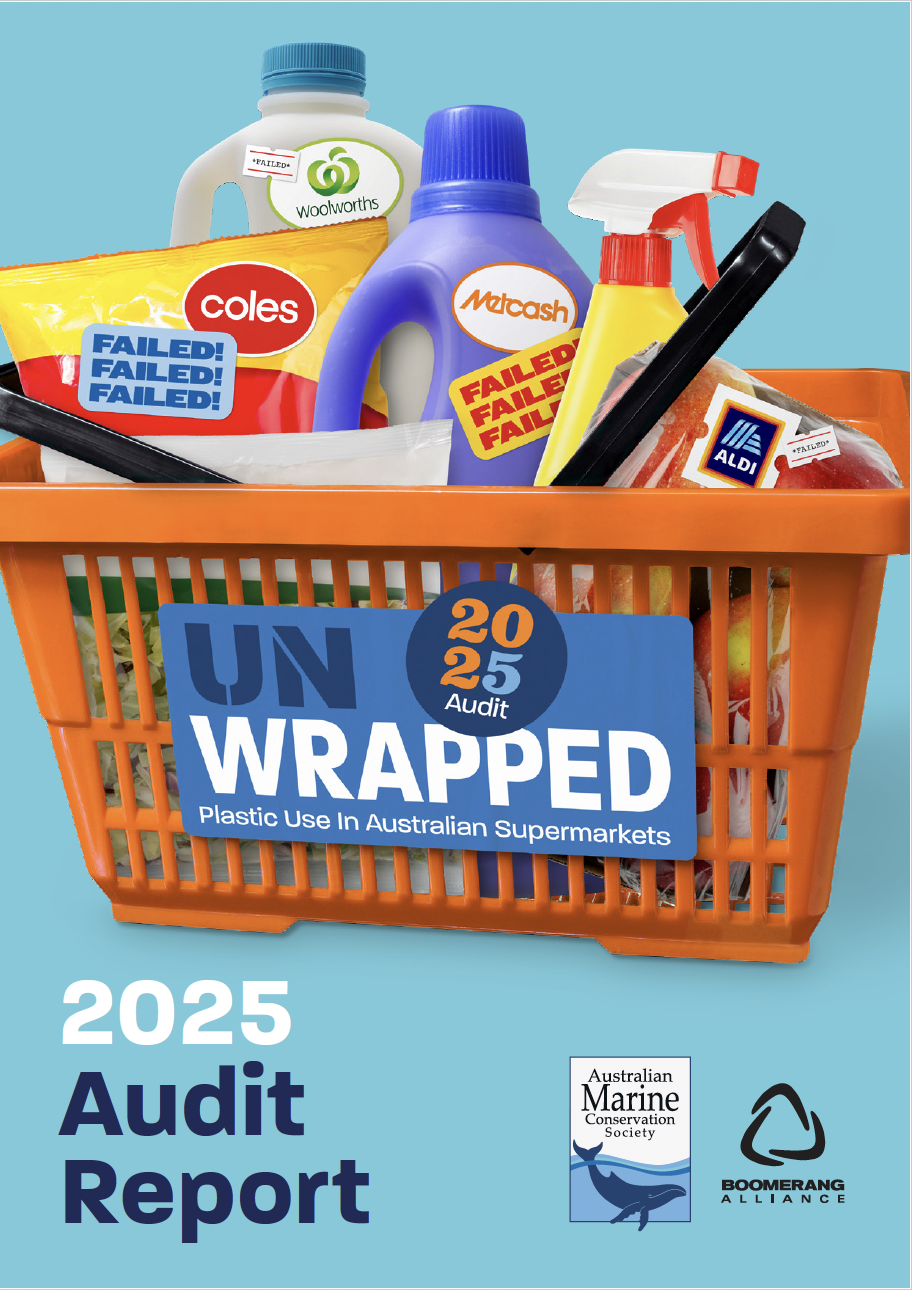
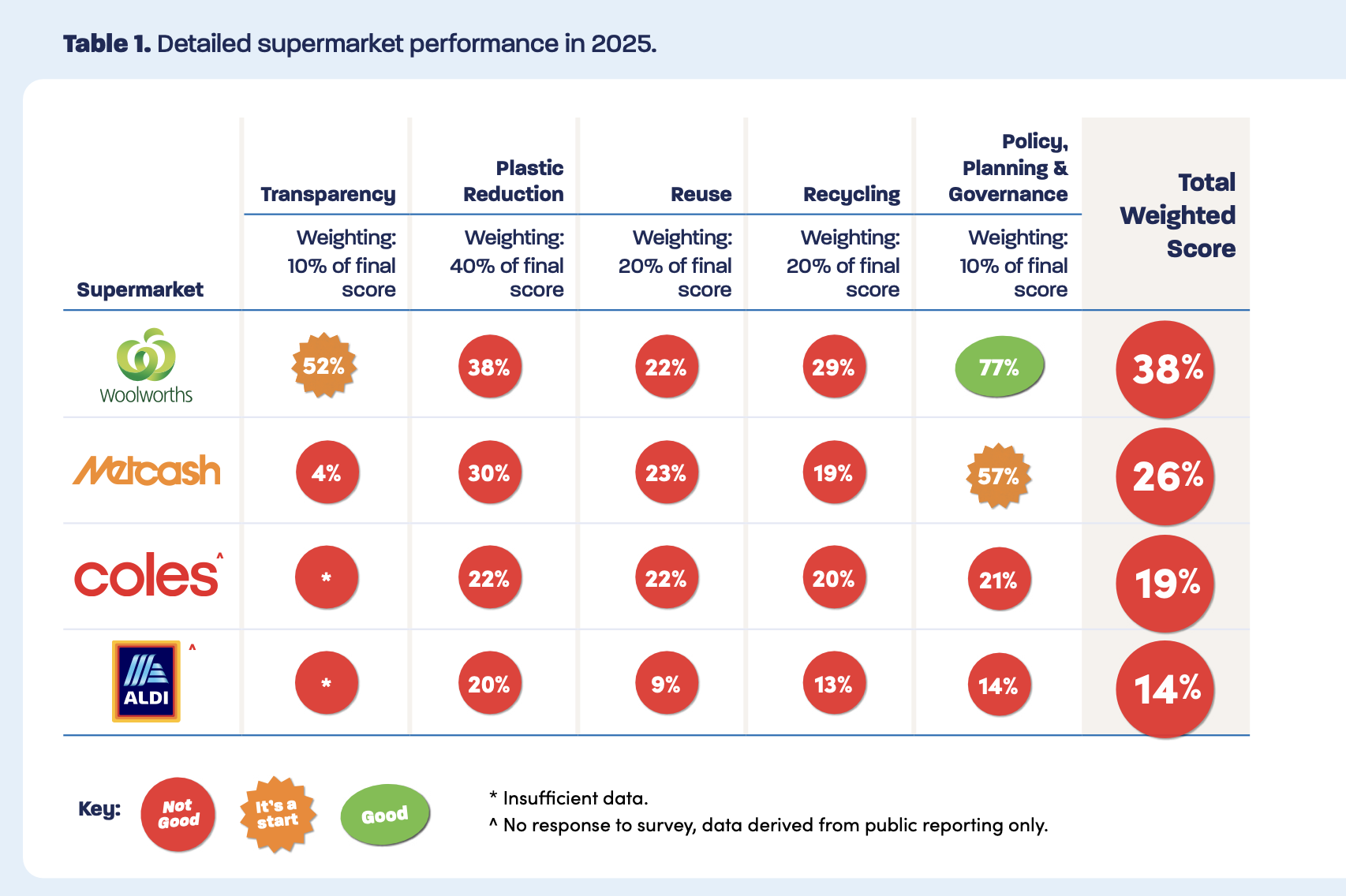
Australia’s big supermarkets are adding fuel to the plastic pollution crisis, with all four failing an independent audit into their plastic use, says the Australian Marine Conservation Society (AMCS) and the Boomerang Alliance (BA). Supermarkets are a $144.3 billion industry in Australia.
Woolworths received scores of 38%, Metcash (IGA, Foodland, Friendly Grocer and Eziway) 26%, Coles 19%, and ALDI 14%. Scores consider five areas: transparency, plastic reduction, reuse, recycling, and policy, planning and governance. Whilst Woolworths and Metcash have made noteworthy improvements since their 2023 scores of 10% and 3% respectively, Coles has lost ground each year and ALDI comes in last after taking top spot in 2023.
Supermarkets Are Failing to Shift Their Plastic Habits: Our 2024 Report

The Boomerang Alliance and the Australian Marine Conservation Society have released the 2024 Supermarket Report, an annual audit of major supermarkets' plastic packaging use. This report is made possible by thousands of passionate supporters who act as secret shoppers, gathering data from their local stores to help us assess what's really happening.
While there have been some improvements, the findings show that supermarkets are still far too slow in tackling their plastic problem. Shockingly, plastic-wrapped fruit and vegetables remain cheaper than loose produce in 73% of cases. Reusable container options are scarce, and supermarkets continue to focus on recycling packaging rather than prioritising reduction or avoidance.
In our rankings, Woolworths came out on top – but only with a score of 38%. This is far from good enough and pales in comparison to leading supermarkets in Europe. Adding to the challenge, recycling labels often mislead consumers, creating confusion about proper disposal.
It’s clear that Australian supermarkets must step up their efforts. For more details, check out our report here.
What Did Our Report First Comprehensive Report in 2023 Find?
Ever wondered how your supermarket ranks? You can take a peek at our first-ever independent audit of supermarket plastic use in Australia.
Aldi leads the way in the Australian supermarket sector, achieving the highest score in 2023, with Coles, Woolworths, and Metcash (IGA, Foodland, and others) foll
owing.
 KEY FINDINGS
- Most supermarkets are not transparent about their plastic footprint.
-
Reuse and refill systems need to be scaled up urgently, to provide consumers with cost comparative options without unnecessary plastic packaging
-
Leading supermarkets are not prioritising removal of plastic, over-relying on false solutions such as 'lightweighting' - making packaging lighter to claim plastic reductions.
-
Loose fresh produce is frequently more expensive than plastic-packed produce, pushing consumers towards unnecessary plastic packaging, and penalises those who try to reduce their plastic consumption in a cost-of-living crisis.
-
Supplier packaging guidelines are rarely enforced, allowing suppliers to use whatever packaging option is cheapest or easiest to print marketing material onto.
- Recycling and recycled content was the worst-performing area of all assessed categories. In spite of the message coming from Australian supermarkets, little real progress has been made on increasing the recycled content in plastic packaging, diminishing recycling efforts and the vision of creating a circular economy for plastics in Australia.
Australians have been doing our part- recycling and picking up trash. But unless we stop plastic at the source, it is just a band-aid solution and our incredible marine life will continue to suffer the consequences.
For more information on our report view our audit framework and volunteer surveys.
You Can Help Keep Supermarkets Accountable
For the first time, Australia’s federal, state, and territory governments have come together to develop new laws on plastic packaging, thanks to pressure from Boomerang Alliance supporters like you.
Will you help us create change today?
Our Wins So Far
- We presented Tanya Plibersek with over 20,000 signatures at Coogee Beach. Check out our 9News coverage here.
-
Sara Gibson published Supermarket Inquiry- What We Have Asked For in Latest News 2024-05-23 11:33:25 +1000
Supermarket Inquiry- What We Have Asked For
The ACCC has been taking submissions from interested parties about the major supermarkets. This has largely been focused on pricing and whether there has been unfair behaviour by the supermarkets with primary producers and consumers. The Boomerang Alliance took the opportunity to present our views on two key issues raised by our supermarket audit run with the AMCS. Those were pricing packaged fresh produce at lower than loose items and the continued misleading recycling information on labels.
In our submission, we stated:
We, and our supporters regularly monitor the actions of supermarkets with respect to packaging. The issue we receive most comment on from supporters and the public is the practice of charging more for loose fruit and vegetables compared to equivalent products that are packaged. This practice provides a clear price incentive to purchase unnecessary packaging. Packaging that councils and their ratepayers have to foot the bill for collection and recovery. In the case of plastic (soft plastics) packaging services, there is no collection service so it all goes to waste (with associated public cost)
Supermarkets offer products in packaging that the consumer accepts will be recovered after use. Reuse and recycling are important considerations for most consumers when making purchasing decisions. Data from APCO (Australian Packaging Covenant Organisation) indicates that less than 20% of plastic packaging is being recovered, and the rest is being wasted. An estimated 3-4% of plastic packaging contains recycled content.
Many supermarkets and brands now use the Australian Recycling label (ARL) to promote their environmental credentials to consumers. The ARL provides information on the recyclability of product packaging and information on its correct discard to avoid waste. Since October 2022, there has been no in-store collection of soft plastics. Despite this, the ARL (provided by the two major supermarkets) still advises consumers they can discard soft plastics in-store. The ARL should be changed if no service is provided.
The ARL itself needs to be reviewed as it suggests to consumers that their packaging (particularly plastics) will be recycled. The ARL description of recyclability needs to be expanded to include the requirements that any packaging is recovered, in practice and at scale.
-
Global Plastic Treaty an Update
The most recent negotiation session for a global marine plastic treaty (Ottawa, Canada 23-29 April 2024) was frustrating and disappointing for many delegates hoping for more progress on an international agreement. That lack of progress stems from the major plastics industries, and a bloc of nations opposing common global rules.
Kate Noble from WWF who attended the meeting has told us that, 'vested economic interests are playing out in these negotiations in a major way. The value of plastics traded globally is estimated by the UN at more than $USD 1 trillion, with rapid annual growth. So oil and petrochemical companies - and countries heavily dependent on oil and gas revenue - are fighting hard in this process to protect profits through growth in plastic production, as other sectors decarbonise.'
A significant majority of countries - more than 100 - are quite aligned in pushing for global rules to ban, phase out and/or regulate the most polluting plastic products and the most harmful chemicals in plastics. And a significant number - including Australia - are engaging in good faith negotiations on how the treaty can reduce plastic production to sustainable measures, as well as possible trade measures.
UN member states are now working towards the final negotiation session scheduled for Busan (South Korea) in November/December 2024. It was intended that this would be the last session before the signing of an international agreement. This may not be the case now.
Australia is amongst the progressive countries who want effective solutions with common global rules. The Boomerang Alliance commends the Australian Government and its delegation for taking this position.
Kate Noble adds that "Australia is playing a very constructive role in negotiations that goes beyond its role as a UN member state. Australia's Kate Lynch has stepped into a high-level coordination role within the negotiations, co-chairing negotiation of the financial package and obligations which will be critical to effective implementation of the treaty in the years to come.'
Please Note: In Australia, the Boomerang Alliance is currently lobbying the Commonwealth Government to introduce a Product Stewardship Scheme for Packaging that will make producers responsible for their packaging. Such a scheme would set an example to the rest of the world on how to manage problem plastic packaging and avoid waste and litter. It would be a practical demonstration of Australia's commitment towards ending plastic pollution.
In a nutshell: What the Boomerang Alliance wants
- Legally binding common and global rules that will change the way plastics are managed in our economies to avoid unnecessary consumption and eliminate waste and pollution
- Introduced Circular Economy measures that make producers responsible for the products they place into the market through their entire lifecycle
- Prioritising action on the types of plastic most likely to be wasted or littered
- Support for fair and equitable global action by providing the means (where it is needed) for all nations to transition away from problematic plastics that impact people and the environment
-
Sara Gibson published Boomerang Alliance have called on major supermarkets to change soft plastics labels in Latest News 2024-04-25 15:46:22 +1000
Boomerang Alliance have called on major supermarkets to change soft plastics labels
In a recent investigation on supermarket practices, we found that many products that used soft plastic wrapping still had labels advising consumers to return the wrapping to the store, even when no collection service existed. The REDcycle soft plastics collection service collapsed in October 2022 and has not been replaced.
In our random sample of products we picked fresh produce and common items, products that would have been packaged more recently.
We also found that some brands had changed their labels to advise the wrapping went to waste. Not a great outcome but more honest.
The Boomerang Alliance has called on supermarkets and other retailers to remove these labels or provide a collection service.
We have asked the Commonwealth and the ACCC to act on this. What is the point of labels if they don't provide accurate information?

See our latest media release on the subject here.
-
Sara Gibson published The Boomerang Alliance calls on Senate to support a National Circular Economy in Latest News 2024-04-18 11:27:08 +1000
The Boomerang Alliance calls on Senate to support a National Circular Economy
In its submission to the Senate Inquiry on Commonwealth waste and recycling policies, the Boomerang Alliance has called for Commonwealth action to fix national waste laws.
The only way to reduce and eliminate waste is to abandon the linear economy model of make-use-throwaway and switch to a circular economy approach. The best way to achieve this is for producers of products to be responsible for their products through their entire lifecycle, not just when they manufacture them.
The Boomerang Alliance has called for:
- A national circular economy policy framework and its regulated adoption by all States and Territories.
- All existing and future product stewardship schemes are to be mandatory schemes.
- Commonwealth policies are to be aligned with State and Territory bans on particular products and landfill disposal, and the promotion of reuse of resources.

-
Supermarket Progress Report
March 2024 

Update: Supermarket Progress Report
Last year in the first independent audit of plastic on Australia's supermarket shelves, The Australian Marine Conservation Society and Boomerang Alliance uncovered a worrying lack of progress in reducing plastic packaging.
As we work towards the second report, we wanted to show you what progress the supermarkets have made since the release of our report.
As a Boomerang Alliance supporter, I wanted to make sure you were kept up to date on how the supermarkets are tracking.
It's been five months since we released Australia's first independent report on supermarkets. Yet every time I walk into a supermarket, I'm astounded by the amount of unnecessary plastic surrounding me.
It's on every shelf, in every aisle. It's at the checkout, it's on our fresh fruit and vegetables and less than 20% ever gets recovered. Mostly it ends up in landfills or littered in the environment and our oceans. By reducing the amount of plastic on supermarket shelves, we know we can drive down the estimated 145,000 tonnes of plastic pollution that flows into Australia's oceans every year 1.
Last year, we conducted Australia's first independent audit of the big 4 supermarkets, so that shoppers like you can clearly see what each of the supermarkets are doing to deal with their plastic addiction.
We've followed up on our Top 5 Recommendations to see how the supermarkets are tracking. While some supermarkets have made progress, others are trailing behind.
1 O’Farrell, K., Harney, F., & Chakma, P. (2021). Australian Plastics Flows and Fates Study 2019-20 - NationalReport. Prepared for the Department of Agriculture, Water and the Environment.
What we're welcoming:
- Woolworths have phased out integrated single-use plastic straws and cutlery in their own-brand products and have a requirement that all products stocked on their shelves do the same by the end of 2024.
- Coles have expanded a trial in SA allowing customers to BYO containers for some deli items.
We're disappointed to see:
- No supermarket has committed to ensure loose fresh produce is the same price or cheaper than pre-packaged fresh produce.
- No supermarket has committed to reducing the volume of single-serve or small portion items.

The big 4 supermarkets in Australia are all claiming they're leading the way in plastic reductions, but we're not seeing the results. In 2023, packaging and soft plastics combined made up 69.7% of all plastics collected in cleans up around Australia 2.
Right now, we're conducting our 2024 audit. We're committed to bringing accountability to supermarkets in Australia and will release the second report later this year.
This work doesn't happen without your support. The supermarkets have now taken notice. We need to keep the pressure on them to get the actions needed.
Jeff AngelDirectorBoomerang Alliance
Australia generates more single-use plastic waste per person than any other country except Singapore - Minderoo Foundation, Plastic Wastemaker Index.
With your help, we have a very rare opportunity to turn the tide on plastic waste and pollution. Australia's environment ministers have recently agreed to an ambitious packaging reform, with federal Minister Tanya Plibersek calling for a "Plastic-Pollution-Free Pacific in our lifetimes" – committing to world-leading regulation in 2024. This is our chance, but it won’t happen without cutting the amount of plastic we use in the first place.
CAN YOU HELP US MAKE THIS HAPPEN?


We would not have been able to do all this work without you and your support by making a donation, signing a petition, sharing our social media posts and sending us words of encouragement. We still have much work to do this year and we hope you will continue to help us.
Please donate so we can continue our fight against plastic pollution. 
